
Engagement is a lagging indicator. Workforce intelligence is the leading indicator that prevents organizational failure. Traditional surveys tell you why your talent left last month. They don’t tell you who is resigning tomorrow. In the Belgian market, where the visibility gap often hides rising burnout and absenteeism, reactive leadership is no longer a viable strategy. You need an employee engagement platform that functions as a strategic partner, not just a digital suggestion box.
We understand the frustration of managing complex human systems with incomplete data. You deserve the relief of professional certainty. This 2026 guide shows you how to move beyond basic pulse checks to use workforce intelligence for predicting risks and driving performance. We’ll explore how to detect turnover triggers early and navigate the transition to AI-driven management with confidence. You’ll gain a clear roadmap for organizational change that replaces guesswork with data-backed foresight.
Key Takeaways
- Static surveys are obsolete. Workforce intelligence allows you to close the visibility gap and anticipate turnover before it impacts your bottom line.
- Choose an employee engagement platform that delivers real-time risk analytics for absenteeism and burnout instead of generic sentiment scores.
- Mitigate the hidden costs of digital transformation by assessing AI anxiety and change readiness at the team level.
- Implement a strategic selection framework that focuses on data depth to uncover the root causes of workforce friction.
- Transition from reactive crisis management to proactive leadership with actionable insights that empower team leads to drive retention.
Table of Contents
- Beyond the Annual Survey: Why Workforce Intelligence is the New Standard
- Essential Features of a 2026 Employee Engagement Platform
- Detecting Invisible Risks: From Absenteeism to AI Anxiety
- Selection Framework: How to Choose the Right Platform
- elli: Turning Workforce Information into Strategic Clarity
Beyond the Annual Survey: Why Workforce Intelligence is the New Standard
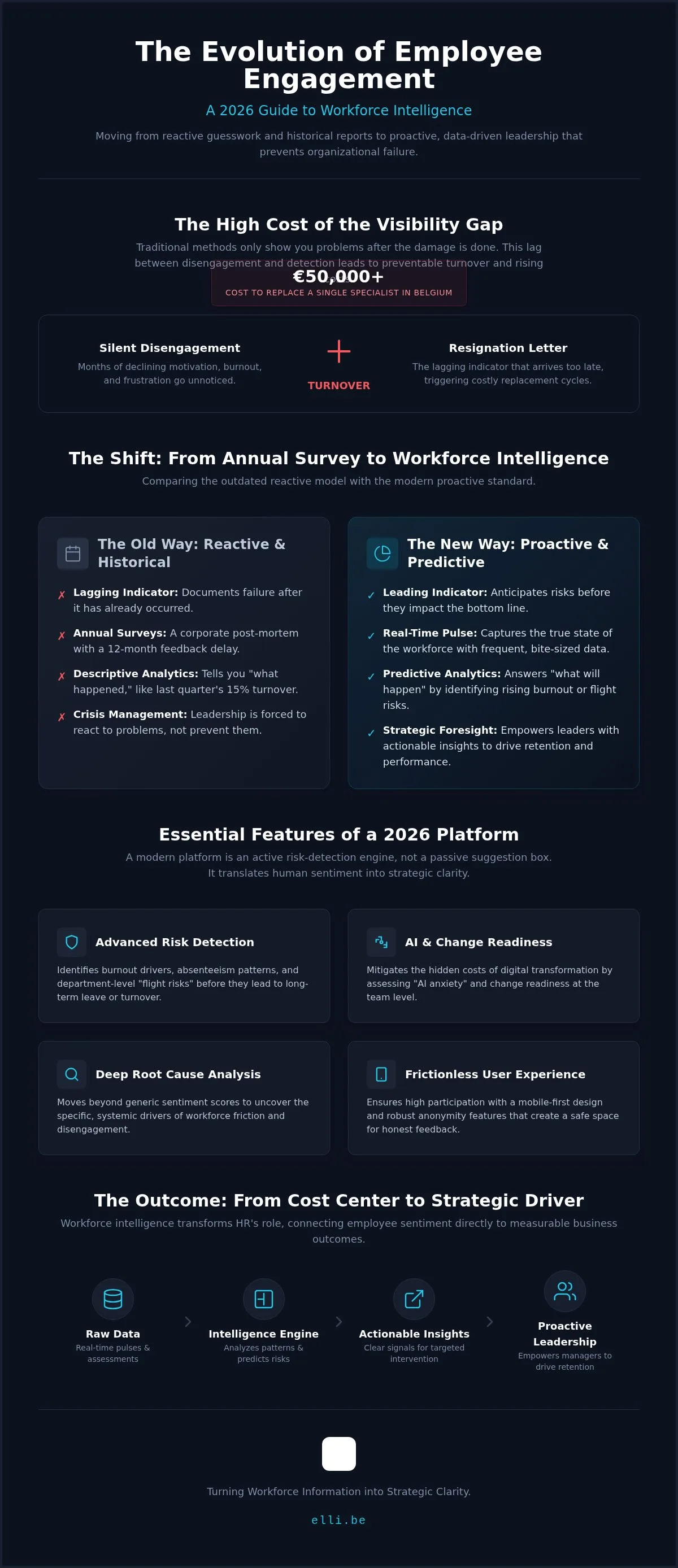
The annual engagement survey is a corporate post-mortem. It documents failure after it occurs. By the time results are analyzed, your highest performers have already checked out. This static approach creates a dangerous lag. In Belgium’s competitive talent market, waiting twelve months for feedback is a luxury you can’t afford. Modern leadership demands a shift toward workforce intelligence. This isn’t just about asking questions. It’s about the strategic intersection of data science and human behavior. It’s the difference between reading a history book and holding a compass.
Most executives operate within a visibility gap. They see the resignation letter but miss the months of silent disengagement that led to it. This gap is where turnover costs accumulate; replacing a specialized professional in Belgium can cost upwards of €50,000 when accounting for lost productivity and recruitment. Workforce intelligence bridges this void. It provides the clarity needed to move from reactive anxiety to proactive leadership. You stop guessing why absenteeism is rising in various parts of your organization. You start seeing the systemic drivers behind the numbers. Clarity replaces guesswork.
The Evolution of Employee Voice
Suggestion boxes and annual reviews are relics. They represent a one-way communication flow that lacks urgency. Today, an effective employee engagement platform utilizes real-time pulse surveys to capture the true state of the workforce. Frequency beats volume. Consistent, bite-sized data points allow for immediate course correction. When you connect employee sentiment directly to business outcomes like performance and ROI, HR moves from a cost center to a strategic driver. It’s about making employee engagement a measurable asset rather than a vague sentiment.
Predictive vs. Descriptive Analytics
Most HR reporting is descriptive. It tells you that turnover was 15% last quarter. This is useful for history books but useless for future planning. Predictive analytics change the game. Instead of reporting on past departures, an employee engagement platform identifies rising burnout risks in specific teams before they result in a talent exodus. It shifts the focus from “what happened” to “what will happen.” Intelligence platforms bridge the gap between raw data and executive action. This foresight allows leaders to implement targeted interventions. You don’t just see the data; you see the path to workforce sustainability. You move from being a witness to being a strategist.
Essential Features of a 2026 Employee Engagement Platform
A modern employee engagement platform is no longer a passive data collector. It’s an active risk-detection engine. Leaders can’t afford to sift through raw spreadsheets to find meaning. They need clear signals. The most critical features in 2026 prioritize visibility over volume. This means moving beyond “how do you feel” to “what is driving this behavior.” You need a system that translates human sentiment into strategic foresight.
Visibility is the antidote to organizational friction. When you integrate specialized assessments for AI adoption and organizational change, you address the human barriers to digital transformation. Fear of technology stalls productivity. By measuring change readiness at the team level, you provide a clear roadmap for executive action. This proactive approach ensures that your investments in technology aren’t undermined by a resistant workforce. You gain the relief of professional certainty in an era of rapid disruption.
Advanced Risk Detection Modules
Belgium faces unique labor pressures, where high absenteeism costs can drain departmental budgets. Your platform must identify burnout drivers before they lead to long-term medical leave. Retention analytics map “flight risks” across departments, highlighting where talent is likely to exit. This allows for targeted interventions. Understanding the “why” behind absenteeism is more valuable than simply tracking the numbers. It transforms HR from a reactive department into a center for workforce sustainability. You can explore these capabilities further with elli’s workforce intelligence platform.
User Experience and Frictionless Data
Data is only as good as its source. Frictionless entry is vital for high participation rates. In 2026, 77% of hybrid workers report being engaged, but this requires tools that bridge the gap between the office and the home. Mobile-first design ensures your entire workforce, including frontline staff, remains connected. Trust is the foundation of this data flow. Robust anonymity features create the “safe space” required for honest feedback. Without trust, you aren’t collecting data; you’re collecting noise.
Automated reporting removes the burden of manual analysis. Insights should flow directly to team leads and executives through intuitive dashboards. Integration with existing Belgian HRIS systems and communication tools like Teams or Slack is a baseline requirement. This connectivity ensures that workforce intelligence is embedded into the daily rhythm of the business. You stop chasing data and start leading with it. The result is a streamlined organization where guesswork is eliminated and performance is predictable.
Detecting Invisible Risks: From Absenteeism to AI Anxiety
Invisible risks are the silent killers of Belgian organizational productivity. You see the absenteeism rates; you don’t always see the psychological friction causing them. “Quiet quitting” isn’t a lack of work ethic. It’s a symptom of a visibility gap. When leaders lose touch with the human pulse of their teams, performance plateaus. An advanced employee engagement platform exposes these hidden drivers. It moves beyond superficial satisfaction scores to reveal the systemic health of your organization. You stop reacting to symptoms and start solving causes.
True wellbeing isn’t found in office perks or gym memberships. It’s found in psychological safety and workload sustainability. In 2026, systemic health is the only defense against burnout. If your data only tracks physical presence, you’re missing the forest for the trees. You need to know if your talent feels empowered or merely processed. Clarity in these areas transforms your culture from a liability into a strategic asset.
Measuring AI Readiness
Digital transformation often stalls at the human level. AI anxiety is a tangible economic risk. It creates a hidden drag on productivity as employees resist new workflows out of fear for their job security. Measuring AI readiness requires a dual approach. You must map technical skill gaps while simultaneously identifying psychological barriers. An employee engagement platform allows you to segment your workforce by their readiness levels. This data-backed approach ensures your training is targeted. You don’t just teach people how to use tools; you build the trust required to adopt them.
The Human Element of Change
Change readiness is a competitive advantage. Most transformations fail because they ignore the human element of the transition. In the Belgian market, where labor regulations and employee rights are robust, managing change requires precision. You can’t force transformation; you must navigate it. Pulse surveys detect resistance in real-time, allowing you to address friction before it hardens into opposition.
Data-backed coaching builds resilience into your team structures. When managers have access to workforce intelligence, they can provide the constructive feedback necessary for growth. Gallup research indicates that 80% of employees who receive weekly feedback are engaged. This isn’t a coincidence. It’s the result of closing the feedback loop. You move from managing tasks to leading people. The result is an organization that doesn’t just survive change but thrives because of it.
Selection Framework: How to Choose the Right Platform
Selecting an employee engagement platform is a high-stakes decision that dictates your organizational resilience. Most leaders fail because they prioritize aesthetic interfaces over analytical intelligence. You need a framework that filters for strategic impact rather than feature volume. First, identify your core workforce risks. Are you fighting a talent exodus, rising burnout, or resistance to digital transformation? A general tool won’t solve a specific crisis. Second, evaluate data depth. A platform that merely shows “what” is happening is a mirror; one that explains “why” is a strategic tool. Third, prioritize actionable outputs for team managers. If the data stops at the HR department, it becomes a bottleneck that prevents real-time intervention. Fourth, ensure total GDPR compliance. In the Belgian market, data privacy is a non-negotiable legal and cultural pillar. Finally, demand a pilot program to test participation rates. High engagement with the tool itself is the only way to ensure the validity of your insights.
The ROI of Workforce Intelligence
Workforce intelligence isn’t a soft cost; it is a financial safeguard. Reducing short-term absenteeism by even a small margin can save a mid-sized Belgian firm thousands of Euro in replacement labor and lost productivity. High engagement scores correlate directly with customer satisfaction and revenue growth. When you lower turnover, you protect your most valuable capital and avoid the heavy costs of the Belgian recruitment cycle. You move from spending on crisis recruitment to investing in long-term stability. The ROI is found in the catastrophic costs you successfully avoid.
Manager Empowerment
True change happens on the front line. An employee engagement platform must serve team leads, not just the C-suite. Managers require tools that facilitate better one-on-ones and provide immediate clarity on team health. Features like automated nudges and context-specific coaching tips transform middle management into a proactive leadership force. This connectivity eliminates the visibility gap between executive strategy and daily execution. When your managers feel empowered by data, the entire organization gains momentum. You can evaluate your team’s change readiness to see how these insights empower your leadership today.
elli: Turning Workforce Information into Strategic Clarity
Workforce intelligence is not a luxury; it is the foundation of modern leadership. elli provides the precision required to move from reactive anxiety to proactive control. Unlike a generic employee engagement platform that only measures sentiment, elli functions as a risk detection engine. We combine traditional pulse surveys with sophisticated analytics to expose the drivers of absenteeism and turnover. This approach eliminates the guesswork that often plagues HR departments. You stop wondering why productivity is dipping. You start seeing the systemic friction before it manifests as a resignation letter.
Our platform is built specifically for the Belgian market. We understand the local regulatory environment and the unique labor pressures facing organizations in Brussels, Ghent, and beyond. This local expertise is embedded into our specialized modules. Whether you are assessing AI readiness, measuring change readiness, or auditing workforce wellbeing, elli provides the strategic support needed to navigate complex transitions. We don’t just provide data; we provide a bridge between raw information and executive action. Clarity is the ultimate competitive advantage.
Workforce Sustainability as a Goal
Long-term organizational resilience requires more than just high engagement scores. It demands sustainability. elli helps you build this resilience by providing team-level insights that allow for targeted improvements. When you identify a turnover risk in a specific department weeks before it occurs, you protect your talent pipeline. These insights empower team leads to have meaningful, data-backed conversations. You move from managing a workforce to sustaining a high-performance culture. This granular visibility ensures that no high-potential employee falls through the visibility gap.
Start Your Transformation
The transition from uncertainty to clarity begins with a single assessment. You can customize your first change readiness assessment to match your current organizational goals. Requesting a demo of our workforce intelligence dashboard allows you to see exactly how these signals appear in real-time. Don’t wait for the next annual survey to discover what your employees are thinking today. Take control of your human systems and ensure your leadership is backed by data. See how elli can transform your workforce intelligence and provide the strategic clarity your organization deserves.
Mastering the Future of Workforce Resilience
Static surveys belong to the past. Proactive intelligence defines the future. You’ve seen how the visibility gap creates unnecessary risk and how detecting burnout and AI anxiety early is the only way to protect your organizational momentum. An effective employee engagement platform must do more than measure sentiment; it must predict outcomes. By empowering your managers with actionable data, you transform HR from a reactive cost center into a strategic engine of growth. Clarity replaces guesswork. Certainty replaces anxiety.
elli provides the specialized AI and Change Readiness modules required for this critical transition. Our platform delivers actionable risk analytics for HR teams, ensuring that no signal of disengagement goes unnoticed. With Belgium-based strategic support, we bridge the gap between raw data and executive action. You don’t have to navigate organizational complexity alone. It’s time to lead with professional confidence and data-backed foresight. The tools for transformation are within your reach.
Book a demo of the elli workforce intelligence platform
today.
Your journey toward a more resilient, data-driven organization starts with a single insight. Take the first step toward proactive leadership and secure your workforce sustainability now.
Frequently Asked Questions
What is the difference between an employee engagement platform and a survey tool?
A survey tool is a digital mirror that reflects past sentiments. An employee engagement platform is a strategic compass that provides workforce intelligence. While survey tools merely collect data, intelligence platforms analyze risk drivers and provide actionable workflows for leadership. It’s the difference between documenting a problem and predicting a solution before the crisis occurs.
How do engagement platforms help reduce employee turnover?
They identify “flight risks” by mapping disengagement drivers at the team level. By the time a resignation letter arrives, it’s too late. Workforce intelligence closes the visibility gap, allowing leaders to intervene with targeted retention strategies. This proactive approach prevents the high costs associated with the Belgian recruitment cycle and protects your talent pipeline.
Is an employee engagement platform GDPR compliant?
Compliance is a non-negotiable legal and cultural pillar in Belgium. Leading platforms prioritize data sovereignty and end-to-end encryption to protect employee anonymity. This builds the trust necessary for honest feedback while ensuring your organization meets all EU data protection standards. Trust is the foundation of data quality; without it, you’re only collecting noise.
Can we measure AI anxiety and readiness with a workforce platform?
Specialized modules allow you to map both technical skill gaps and psychological barriers to technology adoption. Workforce intelligence identifies where fear of automation is stalling productivity or creating friction. This data enables you to craft targeted training programs that address resistance at the human level, ensuring your digital transformation isn’t undermined by a resistant workforce.
How often should we run employee pulse surveys for the best data?
Frequency beats volume for actionable insights. Monthly or bi-weekly pulses are significantly more effective than annual reviews. This consistent rhythm allows you to detect shifts in morale or rising burnout risks in real-time. It facilitates immediate course correction rather than documenting a failure twelve months after it happened. Consistency creates a reliable data stream.
What are the most important metrics to track on an HR engagement dashboard?
Focus on leading indicators rather than lagging ones. Key metrics include burnout risk scores, change readiness levels, and participation trends. An effective employee engagement platform should also track the correlation between manager feedback frequency and team performance. These metrics provide the foresight needed to move from reactive management to proactive leadership.
How do we ensure high participation rates in employee surveys?
Participation is driven by trust and frictionless design. Ensure your platform is mobile-first for diverse workforces and strictly anonymous. Most importantly, you must demonstrate that feedback leads to tangible action. When employees see their input drives organizational change, participation increases naturally. They don’t want to be heard; they want to see impact.
How does workforce intelligence help with absenteeism management?
Intelligence platforms identify the root causes of absenteeism, such as workload stress or toxic team dynamics. Instead of just tracking sick days, you uncover the drivers of short-term leave. This allows for systemic health interventions that reduce the financial burden of absenteeism in the Belgian market. You stop managing symptoms and start solving the causes.